A real-time star tracker sensor model
Reading notes on attitude estimation, realistic sensor noise, and measurement outages for ground-based verification of on-orbit servicing.
Reading note. A study summary of A Real-Time-Capable Star Tracker Sensor Model for Ground-Based Verification of On-Orbit Servicing Applications, presented by Tobias Kamp (DLR) at iSpaRo 2026. Figures are from the DLR presentation, with source credits in the captions.
Motivation
DLR’s OOS-Sim is a ground-based facility for testing on-orbit servicing. A more representative test environment needs sensor models that can reproduce both nominal measurements and the conditions in which measurements fail.
A star tracker estimates spacecraft attitude from known star directions. It complements inertial measurements and other optical sensing, but is itself an optical sensor: bright celestial bodies, limited visibility, and measurement noise can affect its output.
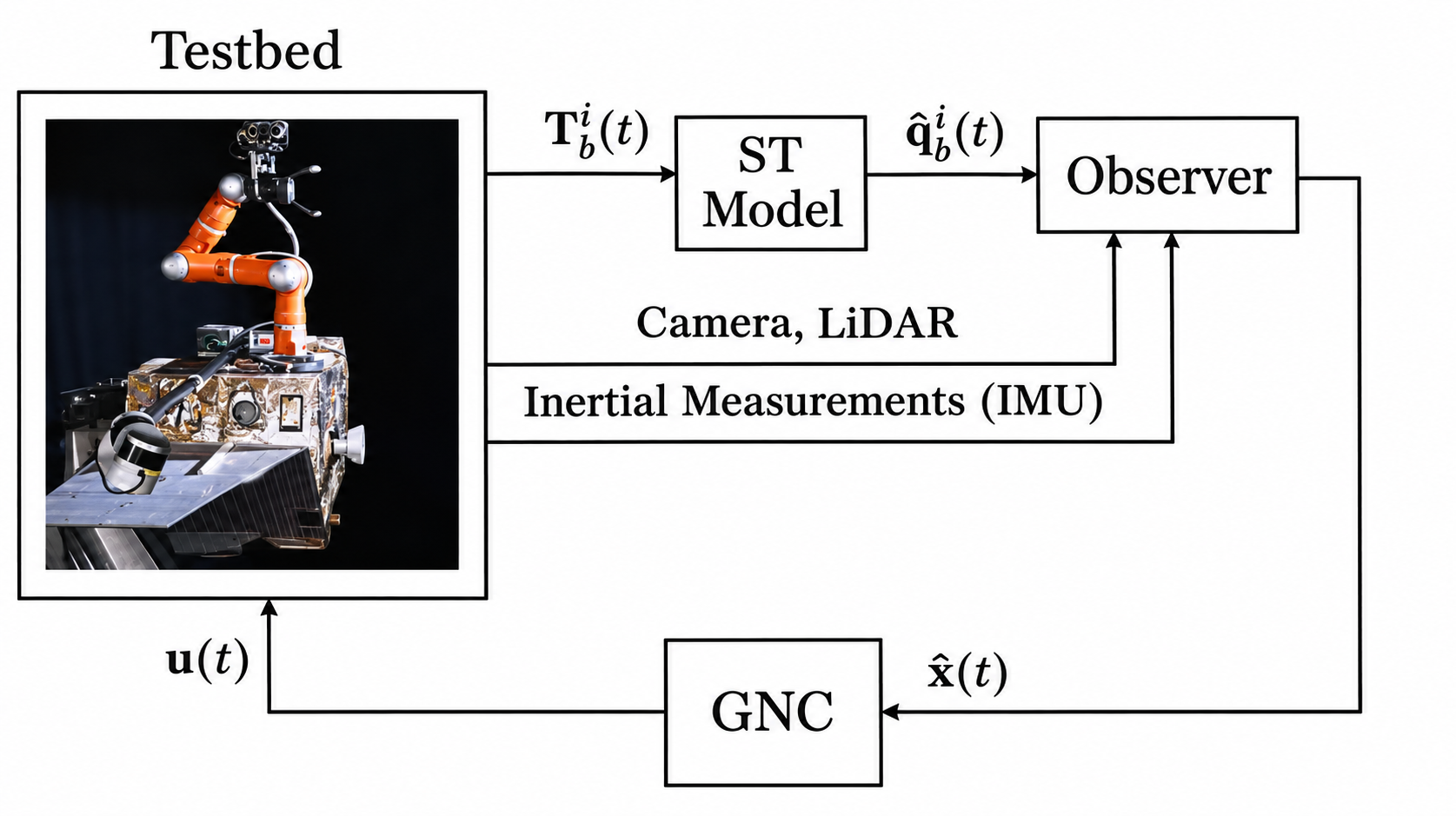
The background facility is described in the OOS-Sim paper (ICRA 2015). The mathematical foundation for star-based attitude estimation is Wahba’s problem and QUEST.
What the model includes
The model targets realistic attitude measurements and measurement availability while remaining fast enough for a real-time testbed.
| Requirement | Modeled behavior |
|---|---|
| Measurement noise | Correlated Gaussian noise and larger uncertainty about the boresight axis |
| Measurement outages | Sun, Earth, or Moon entering relevant visibility or avoidance regions |
| Star catalogue | Star directions based on a real catalogue |
| Adaptability | Configurable sampling rate, noise level, tracked-star count, and calibration parameters |
| Computation | Execution compatible with real-time simulation |
The abstraction omits image formation, detector noise, optical distortion, centroiding, and image-based star identification or tracking. It also leaves out higher-order reference-frame effects, nutation, aberration, and stellar proper motion.
The distinction matters: selecting catalogue stars inside a field of view is not the same task as detecting and identifying stars in an image.
Model concept
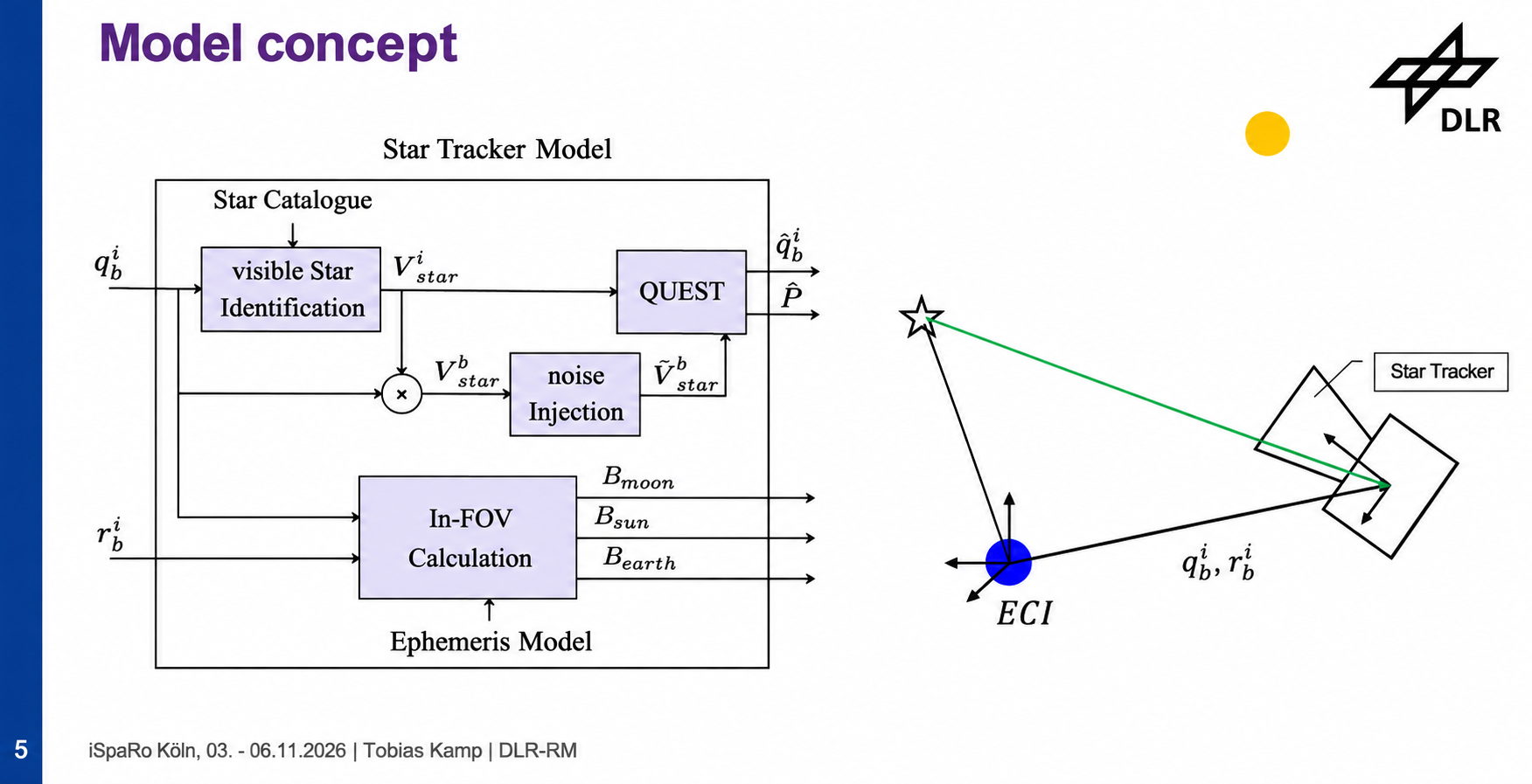
The model receives the spacecraft’s true attitude and inertial position. These feed two related paths:
- Attitude determination: select visible stars, transform their directions, inject noise, and solve for attitude.
- In-FOV calculation: use the spacecraft geometry and an ephemeris model to check whether bright bodies enter relevant sensor regions.
Attitude determination
The star catalogue supplies right ascension and declination, from which inertial star-direction vectors can be obtained. The true sensor orientation and field of view determine which stars are visible.
Selected inertial directions are transformed into the sensor/body frame and perturbed with measurement noise. The perturbed vectors and their catalogue counterparts then enter QUEST, an estimator for Wahba’s weighted attitude-fitting problem.
With the frame convention mapping inertial-frame vectors into the body frame, the objective is
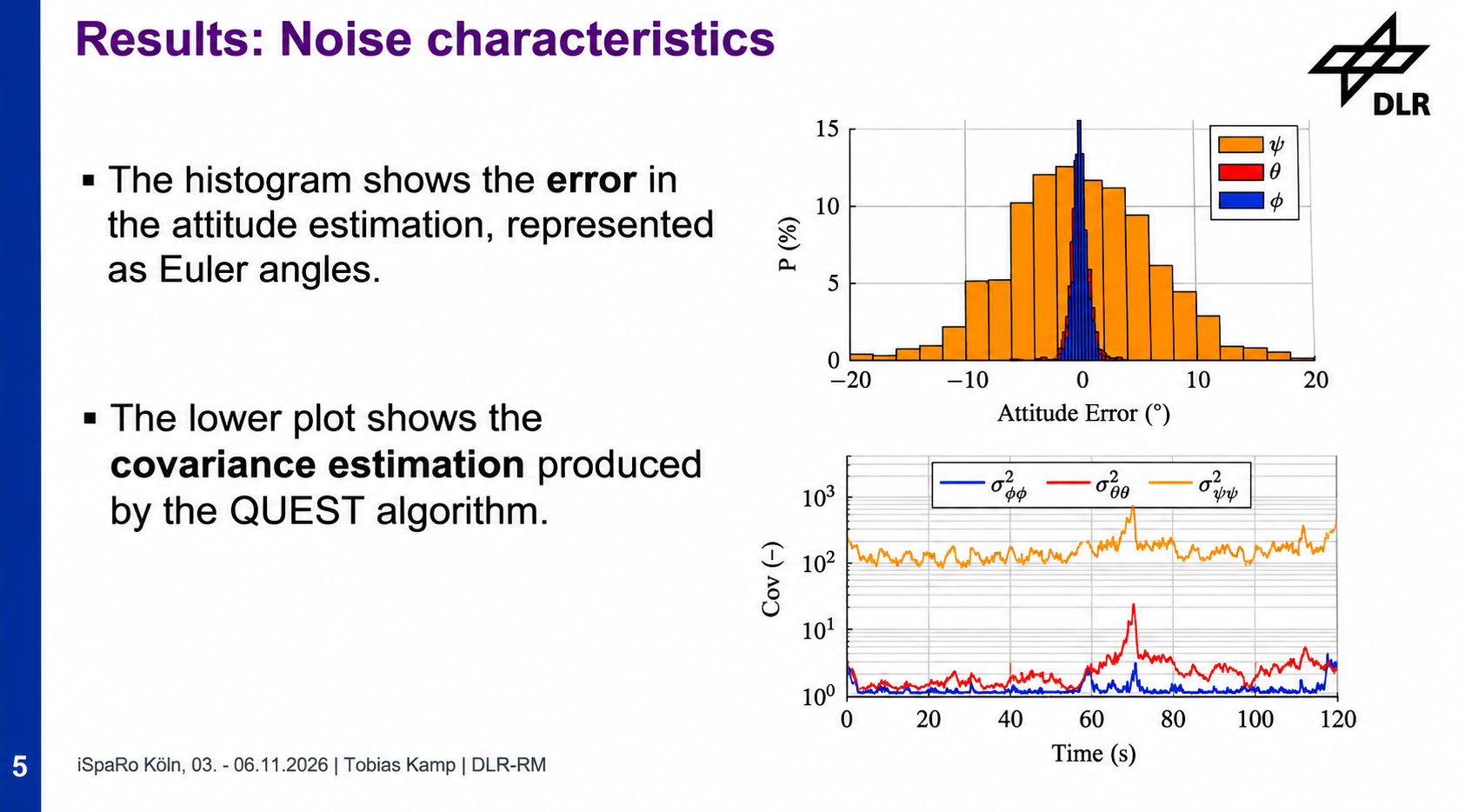
The model provides an estimated attitude quaternion and an estimated attitude-error covariance. The superscripts and denote inertial and body coordinates; weights the reliability of each observation.
Measurement availability
The ephemeris model supplies celestial-body positions over time. Together with spacecraft position and attitude, these support visibility checks for the Moon, Sun, and Earth.
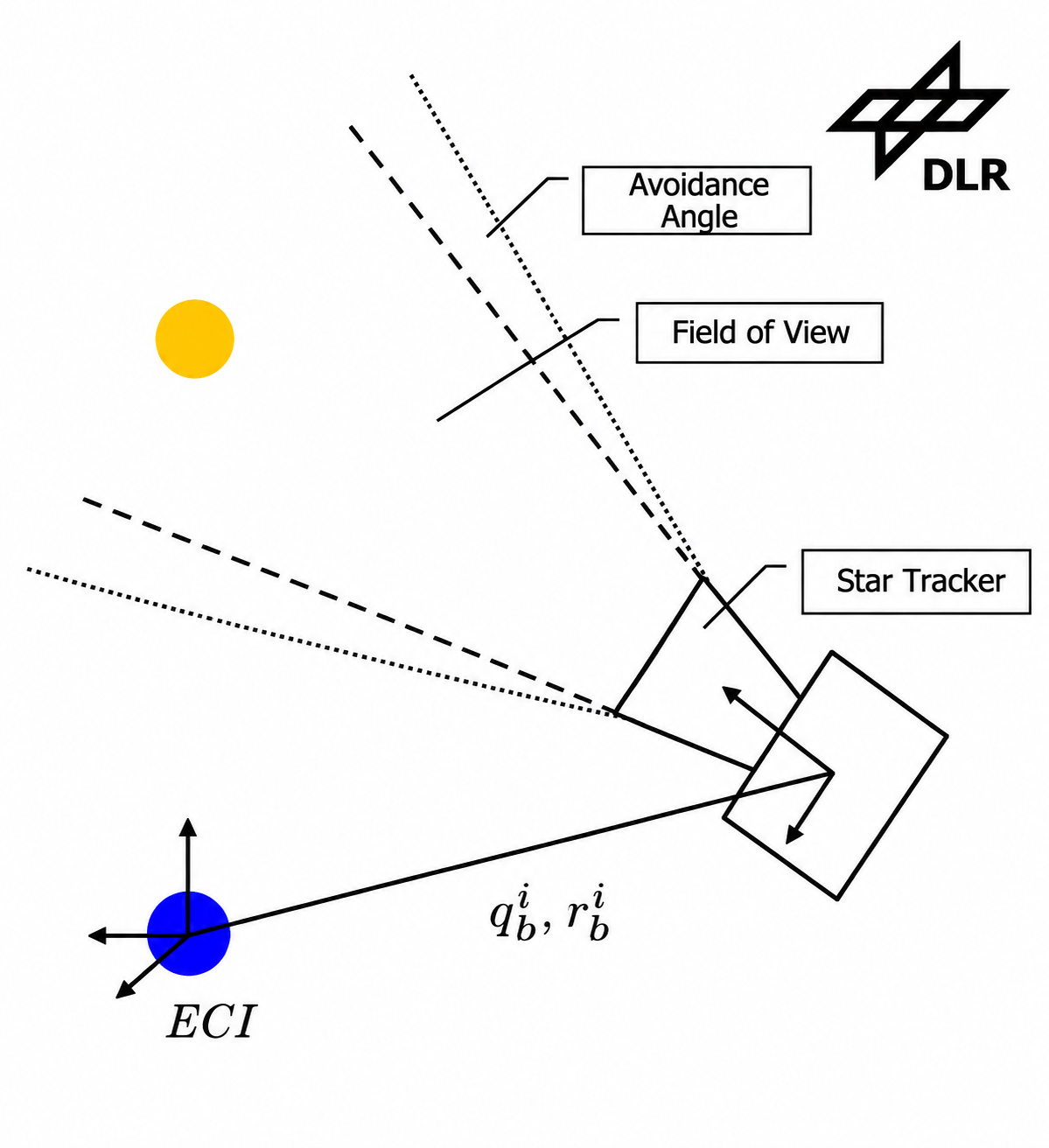
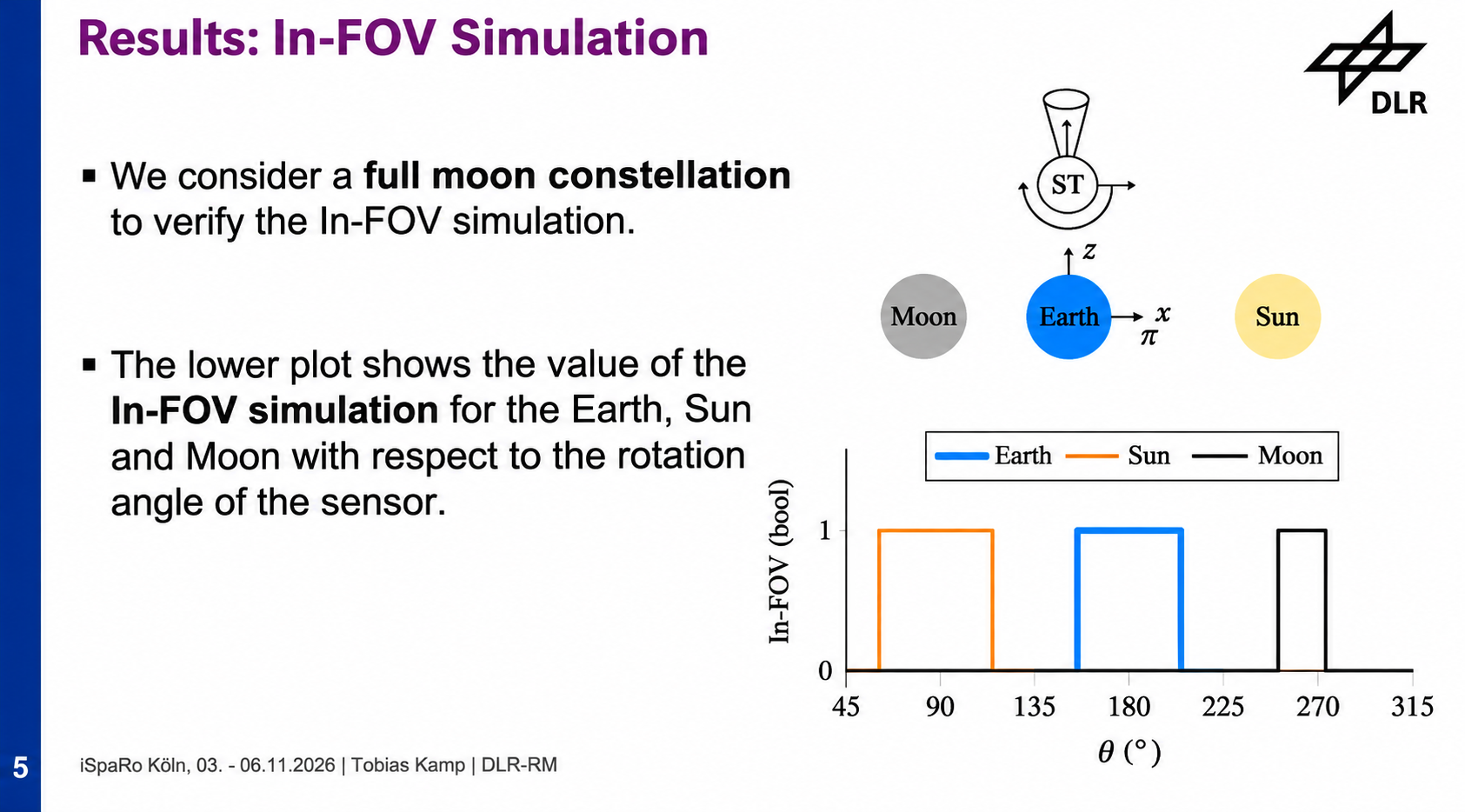
The field of view describes the region used to observe stars. An avoidance angle expresses how far the sensor should remain from a bright body. These checks can flag conditions in which star measurements become unavailable without rendering a complete detector image.
Reported results
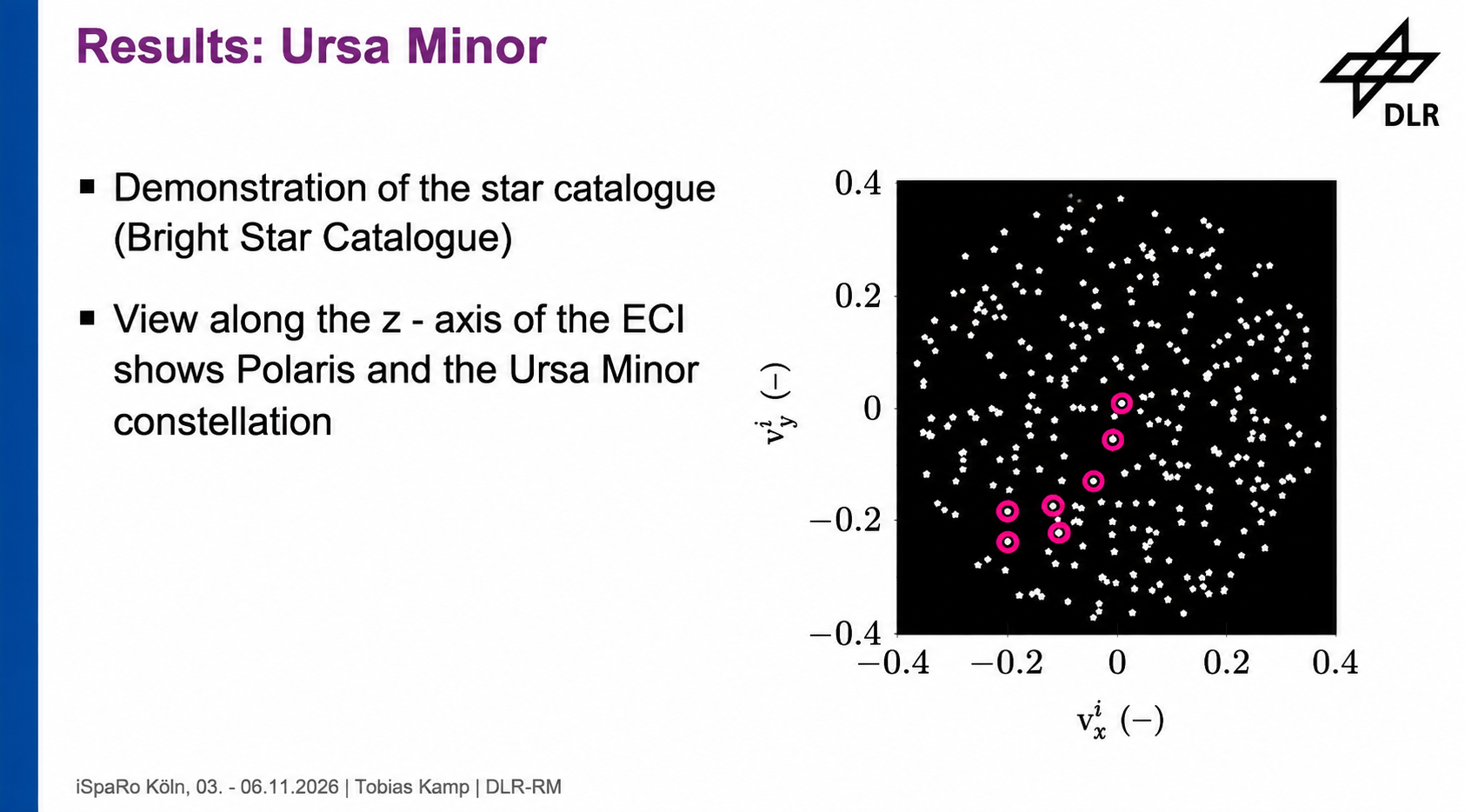
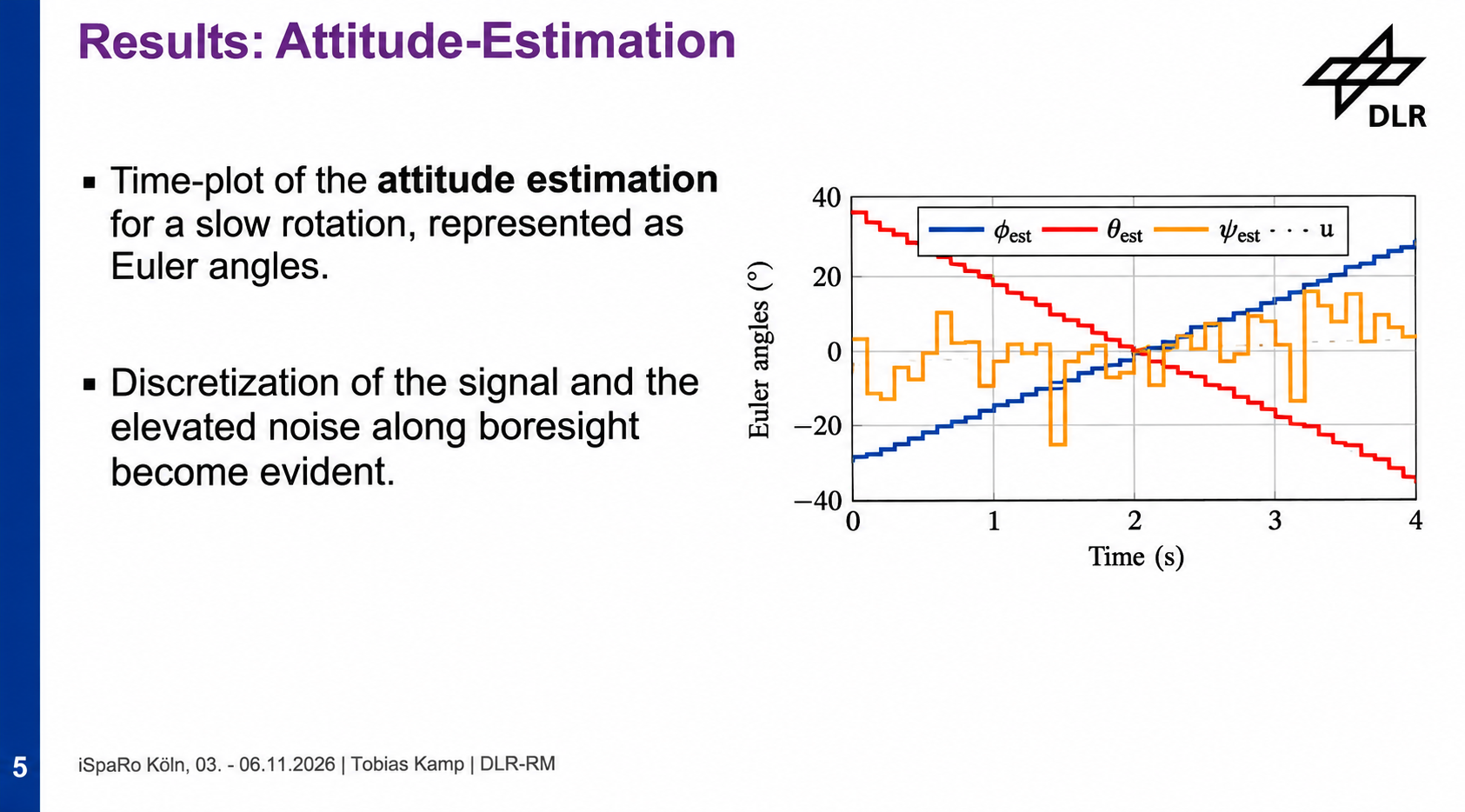
The presentation illustrates catalogue geometry using Polaris and Ursa Minor. Slowly rotating the tracker then demonstrates sampled attitude outputs and the larger attitude uncertainty associated with its boresight axis.
For the visibility example, the notes describe a full-Moon geometry and a rotating tracker, illustrating when the celestial-body flags change.
The implementation uses Modelica and exports through the Functional Mock-up Interface (FMI) for use in tools such as MATLAB/Simulink. My presentation notes record execution at roughly 30× real time in Modelica and 24× in the Simulink FMU. These are reported results for the authors’ setup; the hardware and timing protocol should be checked before using them as a benchmark.
Takeaways
- Choose a model’s abstraction level around the experiment: a GNC verification loop may need credible attitude errors and outages without a full star-image pipeline.
- Preserve direction-dependent uncertainty rather than treating all attitude axes as equally noisy.
- Model availability alongside accuracy. Missing measurements can change estimator behavior even when nominal measurements are accurate.
- Distinguish assumptions supplied by the simulation, such as known star correspondences, from capabilities a real image-processing pipeline must recover.
Sources and related notes
- Tobias Kamp and Marco De Stefano, A Real-Time-Capable Star Tracker Sensor Model for Ground-Based Verification of On-Orbit Servicing Applications, DLR, iSpaRo 2026 presentation. Names and presentation details follow the original study notes and slide attribution.
- iSpaRo 2026 final programme.
- OOS-Sim: ground-based verification of on-orbit servicing.
- Wahba’s problem and QUEST — the attitude-estimation foundation.
These notes were originally written on November 16, 2026. A public preprint or implementation link was not recorded at that time; those links can be added when verified.